Paper trading program open
Run a private perpetual futures desk that is fully reserved before every trade
PerpRelay gives desk owners the rails to offer BTC and ETH perpetual futures to their own clients: index pricing, risk limits, clearing and a double-entry ledger. Every position's maximum payout is locked from the desk's reserve before it opens, so a desk cannot end up owing more than it holds.
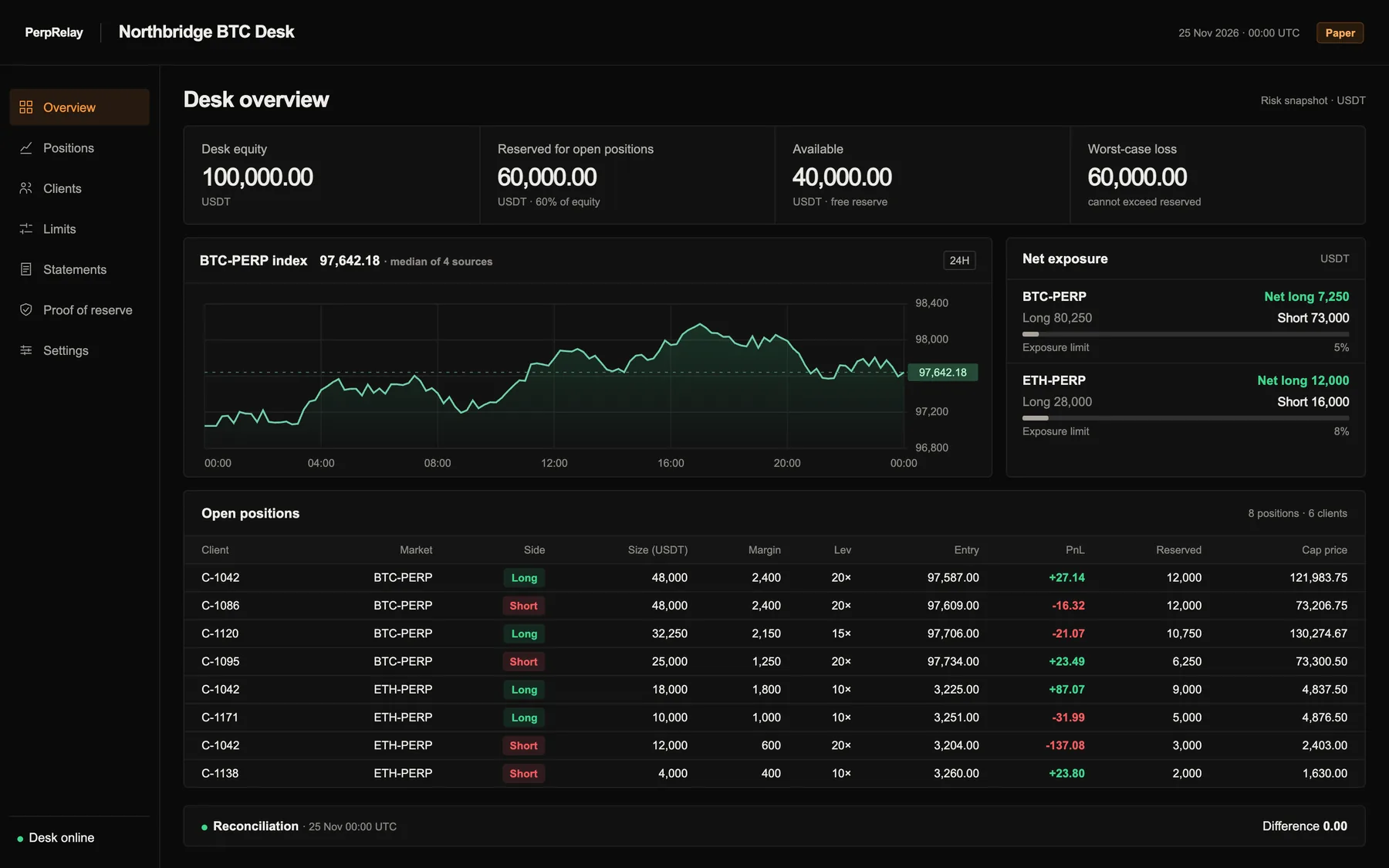
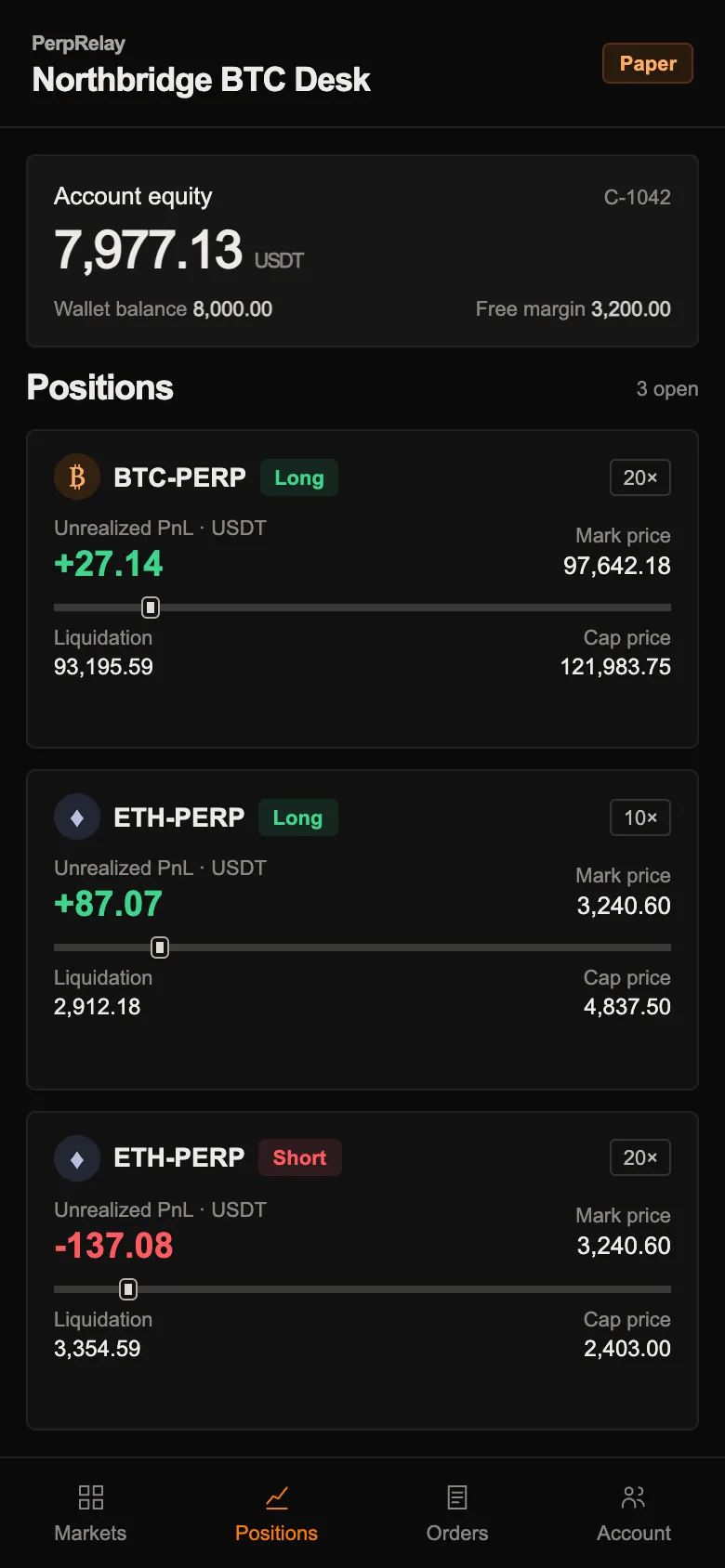

Why PerpRelay
The one way private desks fail, removed by design.
A private desk that takes the other side of its clients' trades is what the industry calls a B-book. It is simple and profitable in normal markets, and it fails in one specific way: a sharp move makes clients win more than the desk can pay. When that happens someone has to cover the gap, and in most setups it is the broker or platform.
PerpRelay removes the gap instead of insuring it. Because each position's payout is capped and reserved up front, the sum of everything clients can possibly win is always covered by money the desk has already set aside. The cost is explicit and shown to both sides: client profits per position have a ceiling, and the desk's capital works less hard than in an uncapped book. The full trade-off is written up in What is a perpetual futures trading desk.

Built on three rules nobody can switch off
Each rule runs in the engine. Desk owners cannot disable them, and neither can we.
01
Payout reserved before the trade

Every position has a fixed maximum payout of 5× margin. That amount is frozen from the desk owner's available funds before the order is accepted. Not enough free reserve means the order is rejected. Why this keeps a desk solvent.
02
Platform is never the counterparty

The other side of every position is the desk owner's capital, never PerpRelay's. Our income is service fees that are deducted and booked separately. Read the six rules.
03
One price nobody can move

Mark price is the median of spot prices from several major exchanges. Desk owners can set a spread, but cannot edit prices or fills. Index price vs last price.
How it works
How a trade moves through PerpRelay.
- Trader submits an order.Size, side, leverage (up to 20× in the paper program) and optional stop-loss and take-profit.
- Risk check runs first.The engine checks the trader's margin, the desk's exposure limits, per-client and per-market limits, and one-sided book protection. Details on the safety page.
- Maximum payout is frozen.5× the trader's margin is moved from the desk's available funds into a reserved balance. If it does not fit, the order is rejected with a clear reason.
- Fill at index plus spread.The order fills at the current index price plus the desk's published spread. The index, each source quote and the timestamp are stored with the fill.
- Close, liquidate or cap out.The position closes by the trader, by stop-loss or take-profit, by liquidation if margin runs out, or automatically when the payout cap is reached. Reserved funds are released or paid out, and the ledger balances to zero difference.
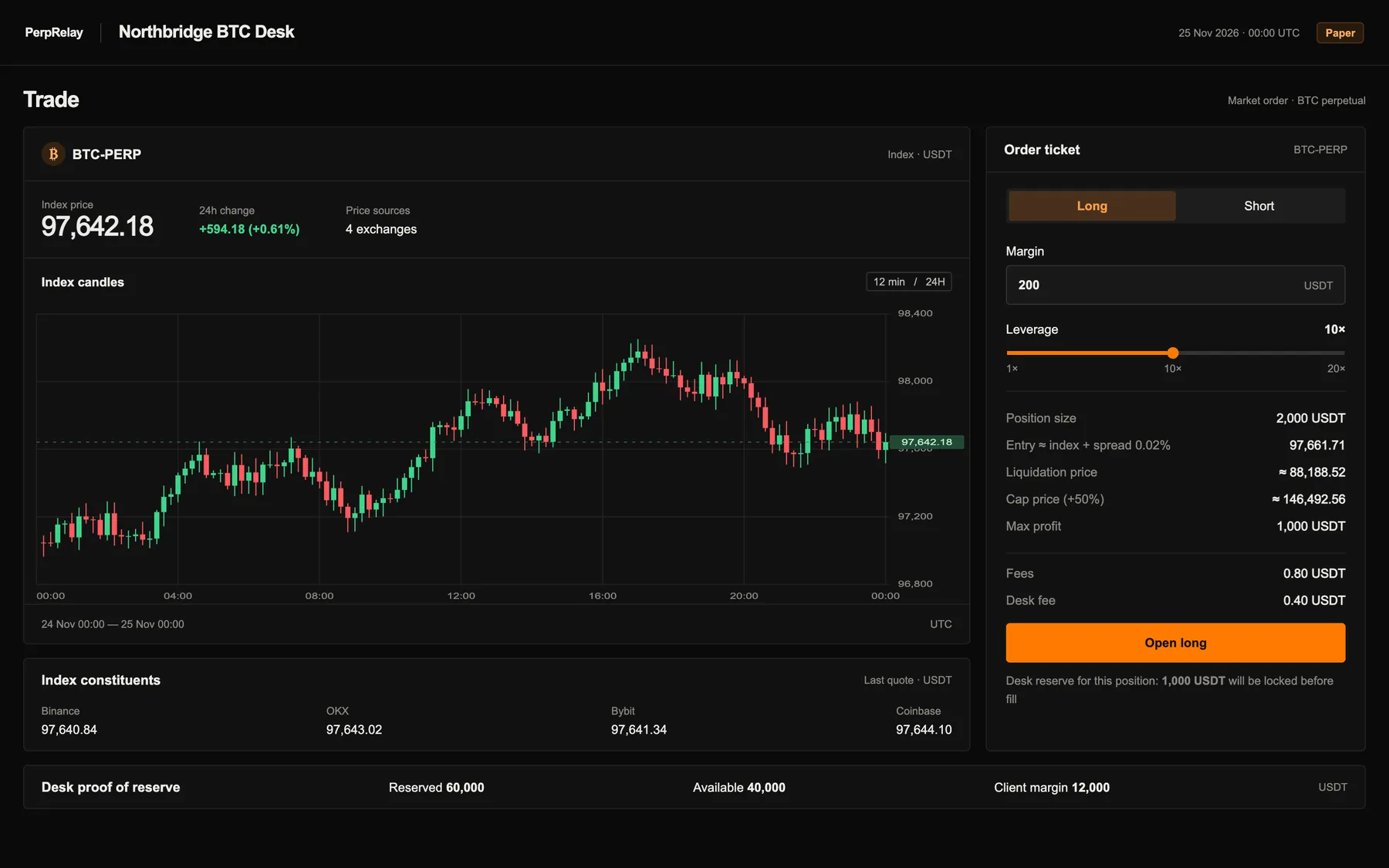
Who PerpRelay is for
One platform, two sides of the same desk.
Desk owners
Trading communities, signal groups, introducing brokers and small funds that already have clients who want perpetual futures, and want to offer it under their own name without building an exchange.
- Open a desk with your own markets, leverage limit and fee mark-up
- Invite clients with your own codes; your desk name is what they see
- Watch exposure, reserved funds and worst-case loss live
- Optional automatic hedging through your own exchange account
Traders
Clients invited to a desk by someone they already know. They trade BTC and ETH perpetuals at index prices and can check the desk's reserves themselves.
- Long or short with stop-loss and take-profit
- Liquidation price and payout cap shown before you confirm
- Proof of the desk's reserve on every page
- Exportable record of every fill and the index at that moment
A typical private desk, and a desk on PerpRelay
| Question | Typical private desk | Desk on PerpRelay |
|---|---|---|
| Can clients win more than the desk holds? | Yes, in a fast market | No. Maximum payout is reserved before each position opens |
| Who decides the price? | Often the desk or its bridge | Multi-exchange median index; no one can edit it |
| Who holds the money? | The desk or the broker | Paper program: simulated funds. Real-money design: a separate on-chain vault per desk that PerpRelay cannot move |
| Can clients check reserves? | Rarely | Proof of reserve on every desk |
| What does the platform earn from losses? | Often a share | Nothing. Service fees only |
Where PerpRelay is today
See the roadmap for the conditions behind each stage and the restricted jurisdictions list.
Now
Paper trading
Desks run with simulated funds on BTC and ETH perpetuals. Open to founding desk owners worldwide by application.
Next
Desktop apps
Signed Windows and Mac apps of the same web platform, downloaded from this site.
Conditional
Real-money desks
Non-custodial vaults on-chain, opened only where counsel confirms it is legal and after an independent audit. Leverage starts at 10×.
Short answers
Is PerpRelay an exchange?
Can I trade with real money today?
What does "capped payout" mean?
Who sets the price?
More questions are answered in the full FAQ. Ready to set up a desk? Apply to become a founding desk, or browse all guides, about us and the terms.

Ready to run a desk you can prove?
Set up a full desk on paper: your markets, your limits, your clients, and a reserve your clients can check.